
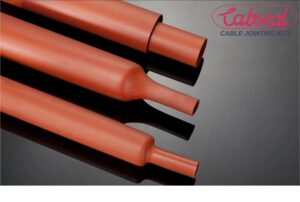
Anti-Tracking Tubing in Cable Jointing Kits
Anti-tracking tubing is a specialized insulating material used in cable jointing kits to enhance the safety and longevity of medium and high-voltage cable connections. Its primary purpose is to prevent electrical tracking, a process where leakage currents across the surface of an insulating material cause erosion, carbonization, and ultimately, failure of the insulation.
Anti-tracking tubing acts as a protective barrier over cable joints and terminations. It is typically made of heat-shrinkable polyolefin or silicone rubber, modified with anti-tracking and UV-resistant additives. When heated during installation, the tubing shrinks tightly over the joint, conforming to the shape of the underlying components and forming a durable, weatherproof, and insulating layer.
Compatibility: Works with other components in cable jointing kits, such as stress control tubing, insulation tubing, and outer protective jackets.
| FEATURES | VALUE | UNIT | STANDARD |
|---|---|---|---|
| Tensile Strength | ≥ 10 | N/mm² (MPa) | ASTM D 638-98 |
| Elongation | ≥ 300 | % | ASTM D 638-98 |
| Longitudinal Change | ≤ 15 | % | ASTM D 2671-98 |
| Density | 1.2 | g/cm³ | ASTM D 792-98 |
| Water Absorption | ≤ 0.1 | % | ISO 62-86 |
| Dielectric Strength | ≥ 20 | kV/mm | ASTM D 149-97a |
| Volume Resistivity | ≥ 1x10¹⁵ | Ohm cm | ASTM D 257-98 |
| Continuous Temperature Range | -40 to +150 | °C | -- |
| Heat Shock (225°C) | No damage | -- | ASTM D 2671-98 |
| Comparative Track Index | 2A 2.5 | -- | IEC 60587-84 |
| Permittivity | 3 | -- | ASTM D 150-98 |
| Fungi Resistance | No Growth | -- | ASTM G 21-96 |